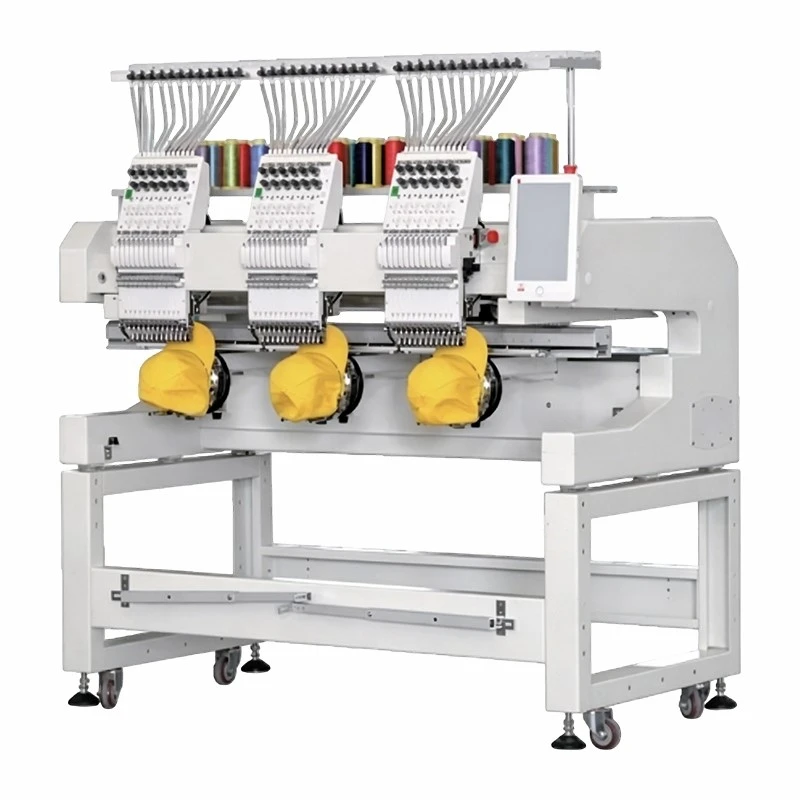
When selecting a professional cap embroidery machine-considering the diverse fabrics and curved structures of baseball caps, bucket hats, and work caps-one must evaluate five specific performance metrics. These metrics distinguish dedicated rotary-head cap embroidery equipment from standard flat-bed machines that have merely been retrofitted.
Rotary Head Coverage and Hoop Compatibility
A professional machine's rotary head (H-axis) must support a rotation range of at least 220°, with 270° coverage being ideal to ensure full-area embroidery across the front, sides, and back panels. Standard equipment should include quick-release hoops for various styles-such as structured baseball caps, soft bucket hats, and wide-brimmed work caps-allowing for style changes without tools and significantly boosting efficiency in mixed-batch production. In contrast, simple retrofitted machines often offer less than 180° rotation, making it impossible to fully embroider the sides or back of the cap, and their hoop compatibility is extremely limited.
Integrated Support for Multiple 3D Techniques
High-quality models natively support five mainstream cap embroidery techniques-3D foam, towel (chenille) embroidery, cording, sequining, and appliqué-without requiring structural modifications to the machine. Standard or retrofitted machines are typically limited to flat embroidery; achieving 3D or raised effects requires additional modifications and hours of setup, leading to frequent downtime for adjustments during mixed-batch runs.
Curved Embroidery Positioning Accuracy
Materials like soft bucket hat fabrics and thick foam are highly elastic; therefore, equipment utilizing a fully closed-loop servo drive system is essential to keep curved embroidery errors within 0.01mm. A machine frame cast from thick, high-grade steel ensures stability during long-term high-speed operation, preventing pattern misalignment or contour distortion across batches. Conversely, frames made of thin sheet metal are prone to high-speed resonance, which easily causes pattern misalignment during 3D embroidery.
Adaptive Dynamic Tension Control System
Materials ranging from canvas and mesh to thick workwear fabrics and lightweight washed cotton vary significantly in thickness. Advanced machines feature AI-based fabric recognition that automatically adjusts bobbin and top thread tension, keeping thread breakage rates extremely low even during thick 3D embroidery. Older models with fixed tension settings require repeated manual adjustments when switching fabrics, leading to significant material waste due to thread breakage during mass production.
Mass Production Capacity and After-Sales Parts Supply
Multi-head models are suited for high-volume factory orders (such as baseball caps), while single-head models cater to small-batch custom orders at retail locations. The brand maintains a nationwide inventory of genuine parts-including cap frames, rotary hooks, and H-axis components-ensuring minimal downtime; in contrast, imported models often require overseas ordering with lead times exceeding a week, resulting in significant losses due to production stoppages.